Feel less afraid of people, one step at a time
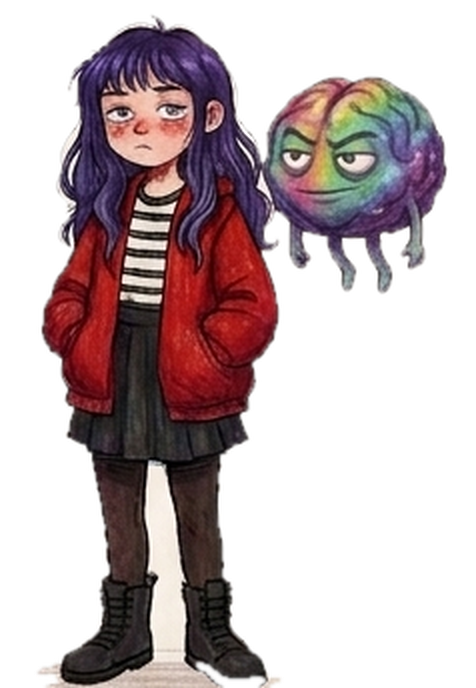
The Social Survival Guide is a workbook for teens with social anxiety. Nix feels everything. Io explains what is going on in her head and suggests one small experiment at a time.
- 35 pages
- Printable A4 PDF
- With a note for parents and professionals
A note for parents and professionals
This workbook supports teens who feel a lot of discomfort around other people. It is a complement: it does not diagnose and does not replace professional support.
The exposure ladder is not suitable when there is bullying or real danger. In those cases, the first step is to protect the teen and talk to the school or a professional.
Let the teen choose the pace and the step. Ask, don't correct.
Noise, masks and shared calm
Some teens get worn out by noise, light and crowds.
Others hide the discomfort and seem fine. It is called masking, and it is very tiring.
Co-regulating means staying calm next to someone who is tense: a low voice, less noise, more time.
What you'll find
Shyness, social anxiety or social phobia?

Only a professional can make a diagnosis.
Your body warns you first
Tick what you feel when you are around other people.
- Heart beating fast
- Sweaty hands
- Tummy in knots
- Hot, flushed face

That is the alarm going off. It does not mean there is danger.
When is it hardest?
Situation
How hard is it (0 to 10)
What I thought

Write without judging. This is just to spot the pattern.
Io makes predictions, you check them
They will laugh at me when I speak.
80% sureThe teacher nodded. Two classmates listened closely.

Was the prediction right? Note it down and compare.
From the easiest step to the hardest
Example. The ladder is yours: choose your steps and how hard each one feels, from 0 to 10.
The step experiment
The step I chose
What I think will happen
What happened
What I learned

If the prediction was wrong, note that too.
My commitment

This week I will try:
Signature:
Nix
+ Io
One step at a time.
Illustrative samples assembled from the workbook outline. Final pages may differ.
Social Survival Guide
An illustrated 35-page workbook for teens who tense up when they have to speak, be seen or be around other people.
No heavy theory: short questions, body exercises and a ladder of small social challenges, chosen by you, from easiest to hardest.
- 1What is this, anyway?
- 2Your triggers
- 3The toolbox
- 4The exposure ladder
- 5Building social confidence
- 6Closing and commitment
One workbook. One price.
Download the PDF, print it and start whenever you like.
Social Survival Guide
One-time payment.
Buy now- 35 illustrated pages with Nix and Io
- Exposure ladder and experiment log
- Note for parents and professionals
- A4 PDF, ready to print
How it works

A glimpse into the world of Nix and Io
Short videos where Io explains what is going on in Nix's head.
The video will appear here once it is published.
Frequently asked questions
If your question is not here, ask someone who supports you. This workbook was designed to be used with support.
It was designed for teens aged 12 and up. Parents and professionals can use it with them: there is a note for adults right at the start.
No. It is a complement and does not diagnose. If the distress is intense or has lasted a long time, talk to a psychologist or a doctor.
After you buy it, you get a link to download the PDF. It is in A4 format, ready to print.
There is no rush. The workbook is organised in six sections, so you can do one at a time, at your own pace.
The exposure ladder is not for bullying or real-danger situations. In those cases, the first step is safety: talk to the school, the family or a professional.
Nix is a teenager. Io is her brain, which goes along with her and explains, with humour, what is happening inside. They also appear in short videos.